
A program that sold its own hardware
Before VisiCalc, the Apple II was a machine for enthusiasts. It had colour graphics, a reasonable keyboard and a price that put it within reach of small businesses — but it had no compelling reason for a finance department to requisition one. The argument for owning personal computing hardware had not yet been made in terms that an accounts manager could understand. VisiCalc made it.
Dan Bricklin conceived the idea while studying at Harvard Business School, watching a professor work through a financial model on a blackboard: change one number, and everything downstream needed recalculation by hand. The vision was a visible calculator — a grid in which values and formulae lived together, and a change propagated automatically. Bob Frankston wrote the working code in a Somerville attic over the winter of 1978 and into 1979, compressing the programme into the Apple II's constrained memory with techniques that would look heroic even a decade later. VisiCalc shipped in October 1979, developed by Software Arts and published by Personal Software.
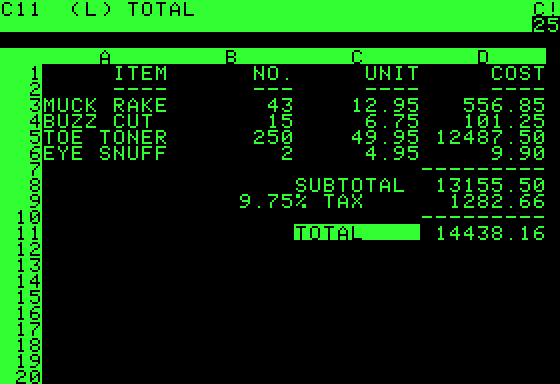
VisiCalc on the Apple II: lettered columns, numbered rows, and a totals block recalculating on every entry.
Screen capture
The immediate effect on Apple II sales was measurable and remarked upon at the time. Steve Jobs later called it the product that had driven the Apple II beyond the hobbyist market. Dealers reported customers who came in specifically to buy the software and treated the hardware as a necessary platform. The phrase that circulated — that VisiCalc was "the tail that wagged the dog" — captured something real about how the software-hardware relationship had inverted. The machine existed to run the programme, not the other way around.
What Bricklin and Frankston had built was conceptually simple and practically transformative. The grid of rows and columns was not a new metaphor — accountants had used ruled ledger paper for generations — but making the grid live changed the nature of financial modelling entirely. A model that previously required an hour's recalculation after any assumption changed could now be re-run in seconds. Sensitivity analysis, which had been laborious enough that many analysts simply skipped it, became trivial. The what-if question, which is the engine of financial planning, had a tool.
Chronology
- Winter 1978–1979Frankston writes VisiCalc code in Somerville, Massachusetts
- October 1979VisiCalc ships for Apple II, published by Personal Software
- January 1983Lotus 1-2-3 ships for IBM PC; VisiCalc's market collapses
- 1984Software Arts and VisiCorp enter litigation over royalties
- 1985Lotus acquires VisiCalc assets; programme discontinued
The architecture nobody documented and everyone copied
VisiCalc established conventions that remain in every spreadsheet written since. The column-letter, row-number cell reference — A1, B12, C3 — was a VisiCalc invention that spreadsheet users now absorb without noticing. The distinction between a cell containing a value and a cell containing a formula was baked in from the start. Forward and backward referencing, relative and absolute addressing: VisiCalc got there first and the industry followed.
Software Arts held copyrights but not patents on the underlying ideas, and that gap mattered enormously. Within a few years, Sorcim's SuperCalc had arrived for CP/M machines, and then Mitch Kapor's Lotus Development Corporation shipped Lotus 1-2-3 in January 1983. Lotus was faster, ran on the IBM PC, added charting and a rudimentary database layer, and ate VisiCalc's market almost completely. Personal Software became VisiCorp, repositioned, struggled, and by 1984 was in litigation with Software Arts over royalties. The litigation consumed both companies. Lotus acquired the VisiCalc assets in 1985, and the programme that had created the spreadsheet market was formally discontinued.

Distribution in the 1980s: one program, one machine, one box.
Thraex picture desk
The business history of that transition is a study in platform dependence. VisiCalc's authors had written for the Apple II at the moment the Apple II was the dominant personal computer. When the IBM PC reset the market, Lotus arrived on the right platform at the right time, while VisiCalc's IBM PC port was slower and late. The product that had invented the category was beaten by a competitor who had studied what it built and shipped it faster on better hardware — which is also, at some level, the story of how the spreadsheet has always moved.
What it decided about everything that came after
The deeper consequence of VisiCalc was not the programme itself but the organisational habit it installed. Finance teams began keeping models in spreadsheets — not just calculations but assumptions, forecasts, versions of the budget, projections run before a board meeting. By the time Lotus and then Excel had absorbed the format and extended it, the spreadsheet had become load-bearing infrastructure in the finance function of almost every business that owned a personal computer. The macro layer that grew on top of these tools was a consequence: once a model became complex enough to run regularly, it acquired automation, and that automation became institutional memory.
The ideas that stuck
Lifted from the piece- Column-letter / row-number cell reference (A1 notation)
- a VisiCalc convention now universal
- Value vs. formula distinction
- a cell holds either data or a calculation, not both ambiguously
- Automatic propagation
- change one cell, all dependent cells recalculate
- Relative vs. absolute addressing
- copy a formula and references shift unless anchored
The period close — the moment at month-end when accounts are frozen, reconciled and reported — organised itself around what the spreadsheet could do. The shape of that process, the sequencing of checks and postings, reflects tools that were designed in the early 1980s and have never fully been replaced. Even organisations running large ERP systems on modern infrastructure typically have a layer of spreadsheets at the boundary where data comes out and is reviewed by a human who needs to ask a what-if question.
Bricklin has written and spoken about the period without bitterness, which is remarkable given how the economics resolved. The inventors of VisiCalc did not become wealthy from the spreadsheet in the way that the platform holders and later competitors did. Frankston and Bricklin earned royalties from Software Arts' sales and then watched the category they created consolidate around products they no longer owned. The absence of patent protection, and the difficulty of patenting software concepts in 1979, meant that the idea flowed freely into every successor product.
What stayed was the model. Every financial analyst who opens a blank workbook and begins typing values in column A is, at some remove, using a system whose grammar was written in a Somerville attic in the winter of 1978. The cell reference, the formula bar, the distinction between input and derived output — these were decisions made at a specific moment to solve a specific problem, and they proved durable enough that nobody has found a reason to abandon them in nearly fifty years. The machine is different. The operating systems are different. The network layer, the collaboration features, the cloud storage: all different. The grid is the same.
That is the measure of what VisiCalc did. It did not just sell Apple IIs. It gave the finance function a cognitive tool that fit how financial reasoning actually works, and the fit was close enough that the tool outlasted every platform it has ever run on.