
Lotus 1-2-3 did not lose to a better spreadsheet. It lost to a platform decision, made years before most of its users noticed anything had changed. By the time the market shifted visibly, the shift was over.
When Mitch Kapor and Jonathan Sachs released 1-2-3 in January 1983, they were building on the proof of concept that Dan Bricklin and Bob Frankston had demonstrated with VisiCalc: that a spreadsheet was reason enough to buy a personal computer. What Kapor and Sachs understood that their predecessors had not was that the machine mattered. VisiCalc ran on the Apple II. 1-2-3 was written specifically for the IBM PC and squeezed every cycle out of the Intel 8088. It was fast in a way that felt physical. Charts rendered instantly. Navigation was keyboard-native. The slash-key menu system became so embedded in users' muscle memory that Lotus would be haunted by it for a decade.
The dominance was not gradual. Lotus 1-2-3 became the best-selling software application in the world within a year of launch and held that position through most of the 1980s. Corporations standardised on it. Financial models were built in it. The macro language, crude as it was, became load-bearing infrastructure inside treasury departments and planning teams. Lotus reached revenues of over $150 million by 1984, making it one of the fastest-growing software companies the industry had seen. IBM legitimised the PC; 1-2-3 legitimised the IBM PC for business.
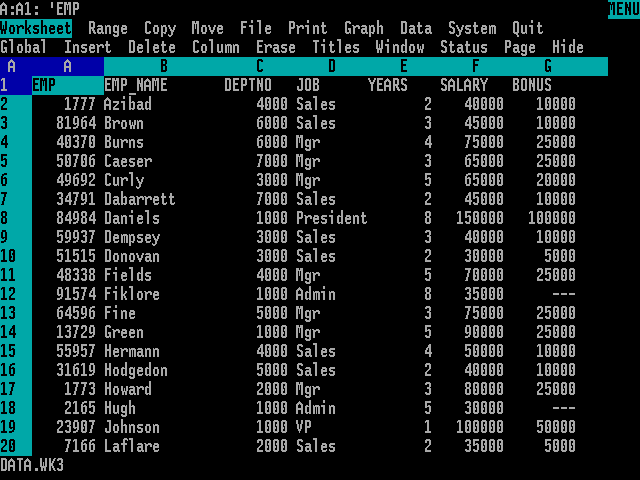
1-2-3, release 3: the slash-key menu across the top, 256 columns lettered A to IV, and 8,192 rows beneath.
Screen capture
Microsoft had been watching. The company had shipped Multiplan in 1982, a year before 1-2-3, and it lost. Multiplan was technically reasonable but it was not written for any single machine, and being written for nothing in particular meant it had no hardware advantage anywhere. Lotus ate it. What Microsoft did next was the decision that mattered: rather than fight 1-2-3 on DOS, the company built Excel for a different platform entirely. The first version of Excel shipped in 1985 — not for DOS, but for the Apple Macintosh. This was not accidental. The Mac's graphical interface let Excel demonstrate things a character-mode spreadsheet could not: proportional type, real mouse interaction, genuine WYSIWYG charts. Microsoft was buying time and buying a proof of concept while Lotus held the DOS market.
Lotus saw this and did not react with sufficient urgency. The internal reasoning was defensible: the Mac was a niche, DOS was the enterprise, and porting a product this tightly optimised for character-mode terminals to a graphical environment was expensive and slow. Lotus had a graphical product in development — Jazz, released for the Mac in 1985 — and it failed. Jazz was slow, overpriced, and confused about what it was trying to be. The failure of Jazz gave Lotus reason to conclude that the graphical market was not ready, which was exactly the wrong lesson.
Timeline of the platform shift
Chronology- January 1983Lotus 1-2-3 launches for the IBM PC; becomes the world's best-selling software within a year
- 1982Microsoft's Multiplan ships and loses to 1-2-3 in the DOS market
- 1985Excel 1.0 ships for the Apple Macintosh; Lotus ships Jazz for Mac, which fails
- May 1990Windows 3.0 releases; Excel for Windows already available
- 1991Lotus 1-2-3 for Windows ships, a year after Excel had established the Windows standard
- 1993–1994Network effects tip; Excel takes the market lead
- 1995IBM acquires Lotus for approximately $3.5 billion; Excel is the dominant spreadsheet
Windows changed the calculation. Microsoft shipped Windows 1.0 in 1985, which was not ready, and Windows 2.0 in 1987, which was still not quite ready. Windows 3.0, released in May 1990, was ready. It sold three million copies in its first year and changed what a DOS-era PC buyer expected to receive. Microsoft already had Excel for Windows, a direct port of the Mac version, running on the new platform. Lotus had nothing equivalent.
The version Lotus eventually shipped for Windows — 1-2-3 for Windows — arrived in 1991, a year after Windows 3.0 had already established Excel as the default for the new environment. The port was troubled. The product had been rebuilt from the ground up to retain the slash-key interface inside a graphical shell, an attempt to preserve the muscle memory of existing users that made the product feel compromised in both directions: not as fast as the DOS version, not as native as Excel. Existing Lotus users had to relearn enough to feel friction without gaining the full benefit. New users, who had no DOS habits to protect, simply bought Excel.
The network effects of standardisation, which had worked so powerfully in Lotus's favour through the 1980s, now ran in reverse. Spreadsheets are collaborative objects. They are sent between colleagues, presented to clients, handed to auditors. When the recipient's machine runs Excel, sending a Lotus file becomes friction. When enough recipients run Excel, the decision is made for you. The tipping point arrived somewhere around 1993 and 1994. By 1995, Excel was the market leader.

Before the software, the deadline. The close is older than every system that serves it.
Thraex picture desk
Lotus did not disappear quietly. IBM acquired the company in 1995 for approximately $3.5 billion, one of the largest software acquisitions of its era. The purchase was primarily for Notes, Lotus's groupware and messaging platform, which IBM wanted as its answer to the networked enterprise. The spreadsheet was secondary. IBM continued selling 1-2-3 for years — the product survived, in diminishing form, well into the 2000s — but the window for relevance had closed. The install base persisted in specific industries and specific countries where standardisation on Lotus had run deep, but no new users were forming attachments.
What makes the Lotus story instructive rather than merely sad is what it demonstrates about the architecture of platform risk. Lotus's advantage in 1983 was that it had been written for a specific machine. That tight coupling to the IBM PC's hardware was its performance edge. But hardware specificity is a bet that the hardware wins. When the interface layer shifted from DOS to Windows, the tight coupling became a liability: the product had to be rebuilt, and rebuilding it meant losing the performance edge that had been its identity. Microsoft, having built Excel first for the Mac and then for Windows, had practiced the graphical port twice before Lotus attempted it once. The muscle was there. The timing was not random.
The mechanism of reversal
Lifted from the piece- Platform specificity
- Lotus's IBM PC optimisation was its 1983 edge and its 1990 liability
- Graphical port experience
- Microsoft had ported Excel to Mac in 1985, then Windows; Lotus attempted one graphical port and it was late
- Network effects as a two-way switch
- the same standardisation force that built Lotus's dominance reversed it once Excel hit critical mass
- The slash-key compatibility layer
- Excel's Lotus-mode was the final marker of the transition: the winner absorbed the loser's interface to ease the one-way migration
The slash key remains a historical artefact of this. Microsoft's own early versions of Excel supported a Lotus-compatible slash-key mode for users migrating across. The victor had absorbed the loser's interface conventions as a migration aid, which is the most complete expression of how thoroughly the platform decision had been made. Users who carried their 1-2-3 habits into Excel were not going back. The compatibility layer was a one-way door.
Platform decisions do not announce themselves. The Windows 3.0 release in 1990 was legible as a technology event; its meaning for the spreadsheet market took two or three years to become undeniable. By the time it was undeniable, Lotus was already in the position from which no product recovers: rebuilding for a platform that its competitor had already defined.