The logic of reduction
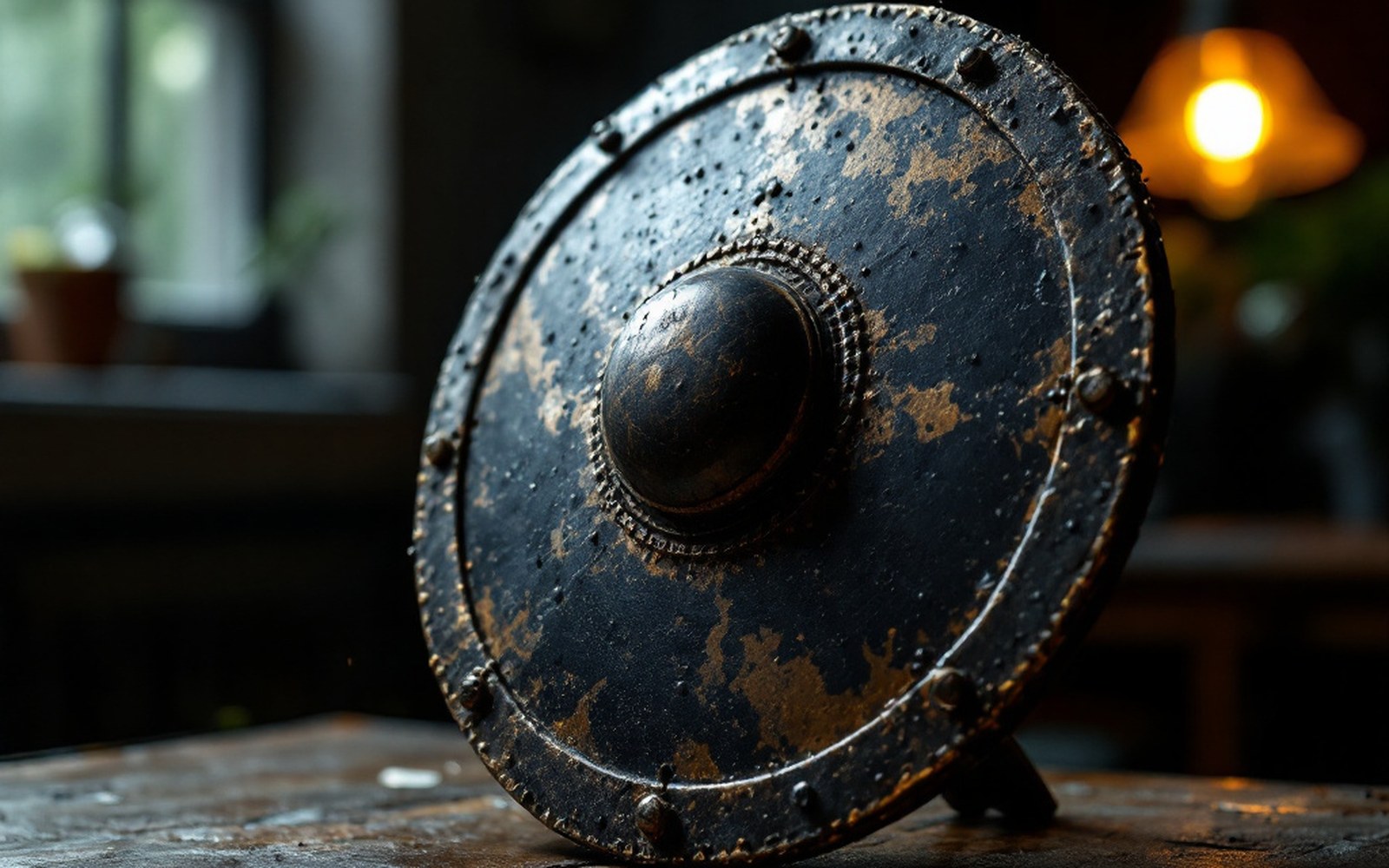
A shield is armour, and armour is weight. Every fighting tradition that developed distinct shield types was, at bottom, solving the same engineering problem: how much protection can a fighter carry before the carrying costs more than the coverage gains? The thraex — the gladiatorial style that took its name and visual identity from Thracian warrior traditions — answered that question by choosing the parmula, a small square shield roughly the size of a modern laptop screen, over the large curved scutum carried by the heavily armed murmillo.
That choice was not made once and then forgotten. It was made visible every time the two types were matched against each other in the arena, which was the standard pairing. Spectators who attended regularly understood the logic on sight: one fighter carried more steel and moved through it; the other carried less and moved around it.
What the parmula decided
The parmula's dimensions meant that a thraex could not anchor a defensive stance the way a scutum-bearer could. Planting the large rectangular scutum and fighting behind it was a coherent tactic; fighting behind a shield that covered only a fraction of the torso was not. The thraex was therefore committed, by equipment, to a more lateral style — angling away from strikes rather than absorbing them, using the sica, the curved short blade, to reach around guards that a straight sword could not clear.
The material argument
Lifted from the piece- parmula
- the thraex's small square shield; lighter than the scutum, covering less of the torso, enforcing a mobile fighting style
- sica
- the curved short blade paired with the parmula; designed to reach around guards that a straight sword could not clear
- scutum
- the large curved rectangular shield carried by the murmillo; enabled a static defensive stance the parmula could not support
- murmillo
- the standard opponent for the thraex; heavier equipment, straight gladius, designed around absorbing and resolving contact
This is the structural point. The shield did not merely accompany the fighting style; it enforced it. A thraex who tried to brawl at close range and soak punishment was fighting against his own kit. The parmula was light enough to redirect and reposition quickly, which rewarded a fighter who read the exchange and moved before contact rather than one who resolved contact by surviving it. The match tempo was therefore faster on the thraex's side — more footwork, more feinting, shorter windows of commitment.
The murmillo's answer was mass. The large shield, the straight gladius, the heavier helmet with its distinctive crest: the murmillo brought more material to the fight and needed the thraex to come to him. The pairing was, in this sense, a designed asymmetry — the arena management and the crowd both knew that two identically equipped fighters produced a less readable contest. Different weapon profiles made the tactical argument legible from the stands.
Weight as commitment
The broader principle is one that appears in equipment decisions far outside the arena. Reducing coverage to gain mobility is a bet, and the bet has to be paid off by skill. A fighter who does not convert the speed advantage of the lighter shield into positional advantage has simply taken on more risk for nothing. The parmula made the thraex harder to play conservatively; it punished hesitation and rewarded decisiveness.
Roman sources and the archaeological record of gladiatorial equipment confirm that these distinctions were maintained as real categories with dedicated gear, not improvised match-by-match. Mosaics, reliefs and surviving helmet types show consistent differentiation between fighting styles across the imperial period. The Zliten mosaic, a large-scale North African floor mosaic likely dating to the second century CE, documents gladiatorial pairings in enough detail to show equipment clearly — including the smaller shield of the thraex alongside the larger protection of his typical opponent.
The parmula was, in that sense, a classification as much as a piece of equipment. Carrying it told everyone in the amphitheatre what kind of match they were about to watch: faster, more conditional, resolved by movement rather than mass. The shield that covered less committed its carrier to a particular theory of winning, and that theory had to be executed under pressure, in public, with no option to revise it mid-bout.